

WIPO Replacement vs. EU Seniority: Similar Idea, Different System
One of the more interesting features of the WIPO Madrid System is something called “replacement.”
We have to admit, it is one of those trademark concepts that sounds more complicated than it actually is.
And what makes it particularly interesting is that it has a lot in common with something European trademark professionals already know well: seniority.
But they are not the same thing.
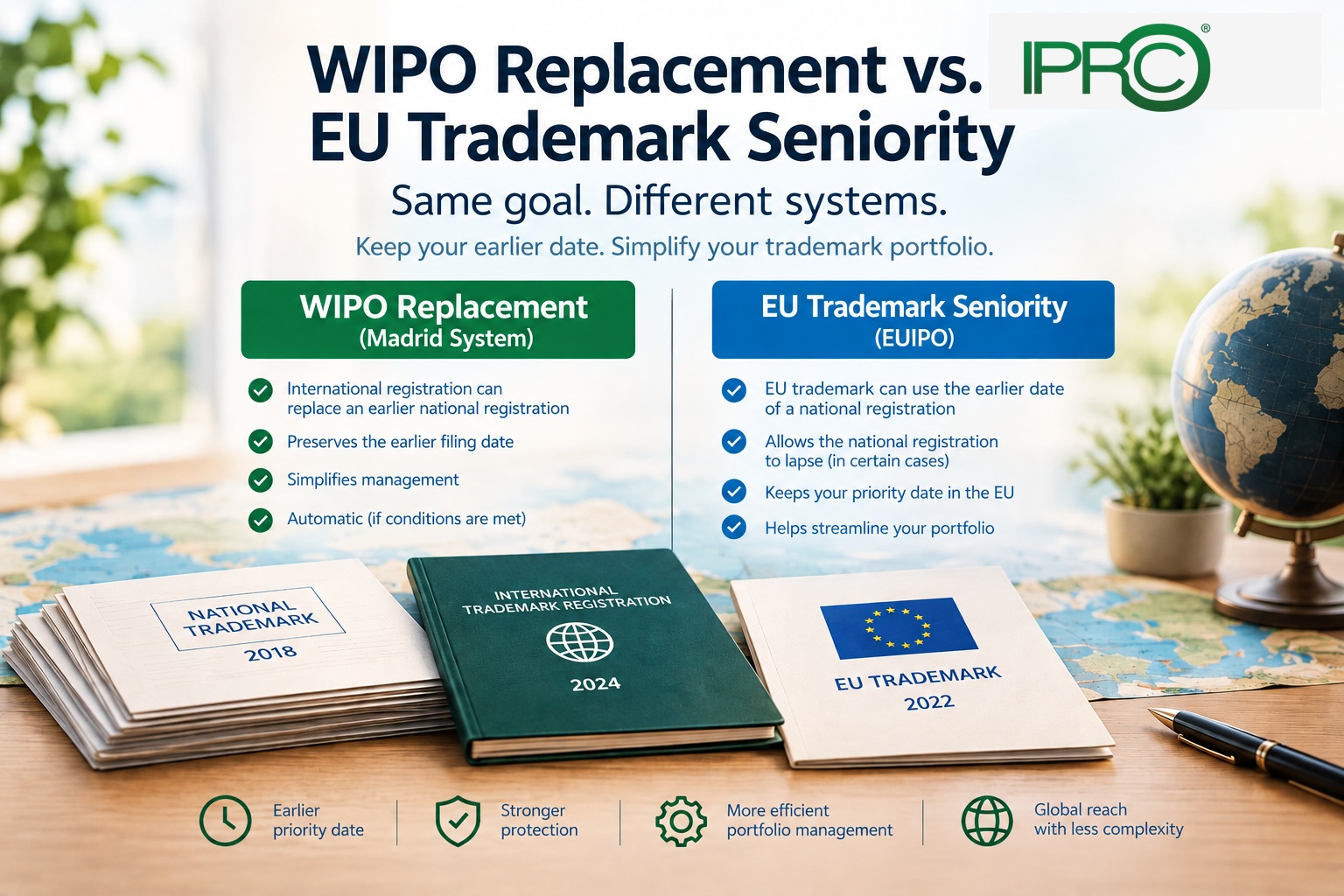 So, what is WIPO replacement?
Imagine this:
You have registered your trademark nationally in Country A in 2018.
A few years later, you obtain an international registration through WIPO and designate Country A.
If certain conditions are met, the international registration is considered to replace the earlier national registration, while preserving the benefit of the earlier national registration date.
That can be very useful for trademark portfolio management.
Instead of maintaining several national registrations separately, you can potentially manage the protection through your international registration.
And this is the part we think many trademark owners don't fully appreciate:
Replacement does not mean that the old national registration simply disappears.
The national registration remains on the national register unless the owner allows it to lapse. The international registration effectively takes over its role while preserving the earlier date of protection.
What are the basic conditions?
The main requirements are relatively straightforward:
- the national/regional and international registrations must be owned by the same holder;
- the international registration must extend protection to that territory;
- the international registration must cover the relevant goods and services;
- the international protection must take effect after the earlier national/regional registration.
There is also an important practical point:
Replacement happens automatically if the requirements are fulfilled.
The owner can nevertheless ask the relevant IP office to record that it has taken note of the replacement. This can be particularly useful if the old national registration is eventually allowed to lapse, because the earlier date is then clearly recorded.
Now compare that with EU seniority
This is where things get interesting.
Let's say you have a Slovenian trademark registered in 2018 and later obtain an EU trademark covering the same mark.
Under the EU trademark system, you may be able to claim seniority of the Slovenian registration for the EU trademark, assuming the relevant requirements are fulfilled.
The practical idea is similar:
You have a later, broader trademark right, but you don't necessarily want to lose the benefit of your earlier national right.
A valid seniority claim can allow the earlier national registration to lapse while retaining its earlier date for the EU trademark in that Member State.
And this is not just a coincidence.
WIPO itself notes that the EU concept of seniority is, in principle, based on the concept of replacement in the Madrid System.
But there is an important difference
The easiest way we think about it is this:
WIPO replacement:
An international registration replaces an earlier national/regional registration in a particular Madrid member.
EU seniority:
An EU trademark can take advantage of the earlier date of a national trademark registration in a particular EU Member State.
So the underlying commercial objective is similar — centralize your trademark rights without unnecessarily giving up an earlier date — but the legal mechanisms belong to different systems.
Why does this matter in practice?
Because trademark portfolios tend to grow messy.
A company may start with:
2018 — Slovenia
↓
2020 — Croatia
↓
2022 — EU trademark
↓
2024 — WIPO registration covering additional countries
Suddenly there are several registrations, different renewal dates, different territories and different administrative requirements.
This is where mechanisms such as replacement and seniority can become strategically valuable.
They are not simply legal curiosities.
They can help answer a very practical question:
“Can I simplify my trademark portfolio without giving up rights that I have already built up?”
That is the question I would ask before automatically renewing every national registration simply because it has always been there.
One important warning
We are not recommend simply cancelling or allowing an old registration to lapse as soon as an international or EU registration is obtained.
With WIPO replacement, for example, the international registration is dependent on the basic mark for the first five years. WIPO specifically recommends caution before allowing the earlier registration to lapse during this period.
There can also be differences in the scope of goods and services, ownership, timing and the specific national procedure.
So this is an area where a seemingly simple portfolio-saving decision deserves a proper check first.
Our takeaway
What we find particularly interesting about replacement and seniority is that both reflect a broader principle in trademark strategy:
A trademark registration is not just a certificate. It is an asset with a history.
And that history — especially an earlier filing or registration date — can have real value.
When a portfolio becomes international, the goal should not automatically be to accumulate more registrations.
Sometimes the smarter question is:
Which rights do I actually need to maintain, and which existing rights can be efficiently integrated into a broader protection strategy?
That is where understanding mechanisms like WIPO replacement and EU seniority becomes much more than a technical trademark exercise.